


A 5,000-year-old story of indigo rivers, carved wooden blocks, and the artisans of Sindh keeping a living heritage alive.
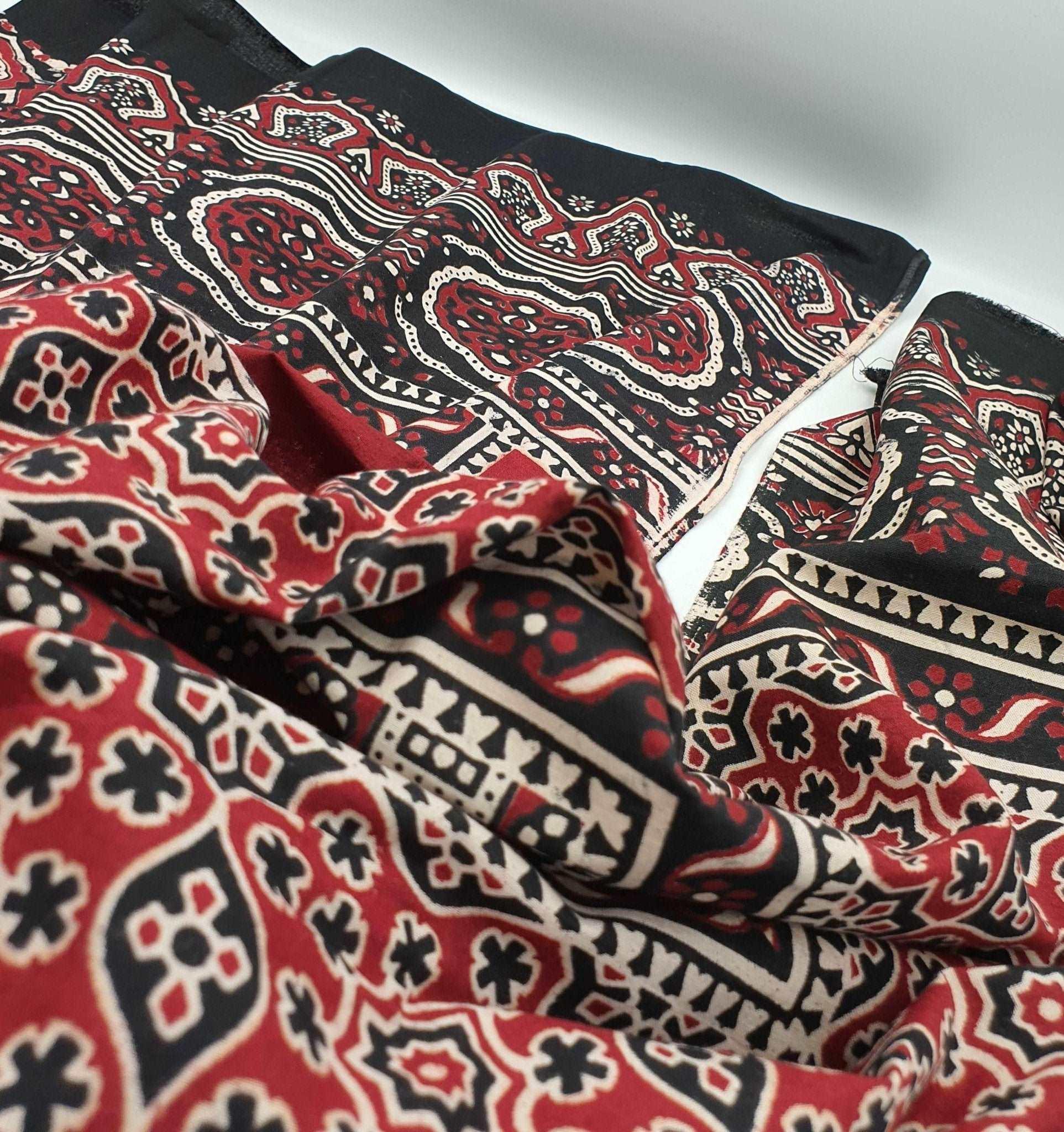
Handmade Sindhi Ajrak — each piece block-printed by artisans in Sindh using natural indigo and madder dyes
If you've ever held an Ajrak in your hands — felt the weight of cotton softened by river water, traced the deep geometric patterns stamped with a carved wooden block — you already sense it is something far beyond fabric. Ajrak is Pakistan's most iconic textile, a living tradition practiced for over 5,000 years that connects us directly to the Indus Valley Civilization. In this guide, we explore its ancient history, the painstaking 21-step process of making one, how to wear it, and why every genuine Ajrak you buy matters.
The 5,000-Year History of Ajrak
The story of Ajrak begins not in a workshop, but in the ruins of Mohenjo-daro — one of the world's oldest cities, built along the Indus River around 2500 BCE. A stone bust excavated there, known as the "Priest-King," shows his shoulder draped in cloth with trefoil patterns identical to Ajrak motifs still printed in Sindh today.
This means Ajrak is not hundreds but thousands of years old. The same patterns, the same resist-dye techniques, the same deep indigo and crimson colors — passed down through unbroken generations for five millennia.
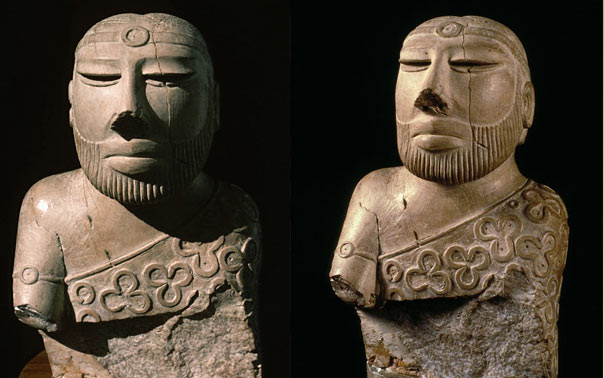
The "Priest-King" of Mohenjo-daro (2500 BCE) — his draped shawl bears trefoil patterns consistent with Ajrak motifs still in use today
The name itself carries history. Most scholars derive Ajrak from the Arabic word azrak, meaning blue — the sacred indigo blue that is the soul of every authentic Ajrak. Ancient records show Egyptians imported cloth from Sindh to wrap sacred mummies. In 500 BCE an Ajrak was presented to Persian King Darius I at his coronation. Arab merchants traded Ajrak across the Arabian Sea from the 9th to 14th century.
How Ajrak is Made: The 21-Step Process
Creating a single Ajrak is one of the most labor-intensive textile processes in the world. From start to finish, a traditional Ajrak passes through 21 distinct stages, taking skilled artisans up to four weeks to complete.
-
01
Washing in River Water
Raw cotton is washed repeatedly in river water to remove impurities and open fibers for dye absorption. The Indus River's mineral composition makes it ideal for this stage.
-
02
Oil Soaking
The cloth is soaked in Eruca Sativa (taramira) oil, bundled tightly, and left to rest for up to two weeks — helping natural dyes bond permanently with the cotton fibers.
-
03
Resist Paste Application
A paste of lime, acacia gum, and rice is applied to areas where dye should not penetrate — creating the distinctive white geometric patterns of the finished Ajrak.
-
04
Hand Block Printing
Carved wooden blocks — some as old as the artisan families themselves — are stamped onto the cloth by hand with remarkable precision. Each pattern requires multiple blocks and perfect alignment.
-
05
Indigo Dyeing
The cloth is submerged in fermented indigo vats — deep blue derived from the Indigofera Tinctoria plant. Multiple dips build the signature rich indigo color.
-
06
Madder (Red) Dyeing
Crimson red is derived from madder root — immersing the cloth creates the bold red tones that pair with indigo in every classic Ajrak.
-
07
Sun Drying & Final Wash
Open sunlight sets the colors and gives the fabric its depth. A final wash removes the resist paste, revealing the completed pattern in all its richness.
 Hand block printing by artisans
 The finished Ajrak stole
What Ajrak Means in Sindhi Life
No textile in Pakistan carries more cultural weight than the Ajrak. It is present at every milestone of Sindhi life — a newborn is laid in a cradle lined with Ajrak. A bride drapes it at her wedding. An elder is honored with one as a gift of respect.
"To drape someone in Ajrak is to say: you are welcome here, you are one of us."
— Sindhi cultural traditionWhen a dignitary visits Sindh, the highest gesture of welcome is to drape an Ajrak over their shoulders. Former Prime Minister Benazir Bhutto was famously photographed wearing an Ajrak as a mark of her Sindhi heritage. In 2025, the Government of Sindh introduced vehicle registration plates featuring an Ajrak-inspired design — a testament to how deeply this textile is woven into the province's identity.
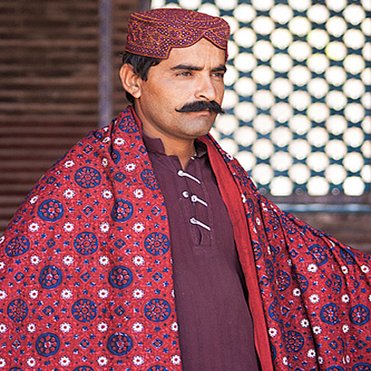
How to Wear & Style Ajrak
One of the most beautiful things about Ajrak is its versatility. Whether you prefer traditional or contemporary style, there is an Ajrak look for everyone.
As a Stole / Dupatta
The most classic use — draped over the shoulders or around the neck, pairing beautifully with solid-colored shalwar kameez that let the Ajrak patterns take center stage.
As a Shawl (Men & Women)
Wrap around the shoulders on cool evenings. Sindhi men wear Ajrak shawls at weddings and cultural events as a mark of heritage and pride.
Head Covering
Draped lightly over the head for a graceful, traditional look — particularly stunning in Ajrak's deep indigo and crimson tones.
Contemporary Styling
Layer over Western outfits, use as a table runner, or frame as wall art. Ajrak's geometric patterns translate effortlessly into modern aesthetics.
Real Ajrak vs. Fake: How to Tell the Difference
As Ajrak has grown in popularity, the market has been flooded with machine-printed imitations. Here is how to spot a genuine hand block-printed Ajrak:
-
—
Check the reverse side. Authentic hand block-printed Ajrak shows the design clearly on both sides — dye penetrates fully. Machine prints are faded or absent on the back.
-
—
Look for slight imperfections. Real Ajrak is made by human hands — patterns may have tiny misalignments. Perfect precision across the entire fabric signals machine printing.
-
—
Smell the fabric. Authentic Ajrak made with natural dyes has an earthy, organic scent. Synthetic dyes have a harsh chemical odor.
-
—
Test color over time. Machine-made Ajrak loses color quickly with washing, while genuine natural-dyed Ajrak improves in softness and character over time.
-
—
Ask about the source. Genuine Ajrak comes from artisan communities in Matiari, Hala, Bhit Shah, Sukkur, or Hyderabad in Sindh. A trustworthy seller will always know the origin.
Why Buying Handmade Ajrak Matters
The Ajrak craft is under threat. Over recent decades, more than 30 traditional Ajrak workshops in Sindh have closed — replaced by machine printing operations. When you buy a genuine hand block-printed Ajrak, you are sustaining a family of artisans who have carried this knowledge across generations.
At QUMAS, we source our Ajrak directly from skilled artisans in Sindh, paying fair prices that reflect the extraordinary labor behind each piece. Every Ajrak we sell is hand block-printed using traditional carved wooden blocks and finished with natural dyes — no shortcuts, no machines.
"Every Ajrak you buy from QUMAS goes directly to sustaining an artisan family and keeping a 5,000-year-old craft alive in Pakistan."
— QUMAS